X
Our staff will contact you within 12 hours, You can also contact us through the following ways:
Contact US WhatsApp: +86 18263873187
- Email: [email protected]
- Tel: +86 18263873187
- Web: www.lifting-chain.com



How to Calculate Chain Sling Capacity: Complete Working Load Limit Guide
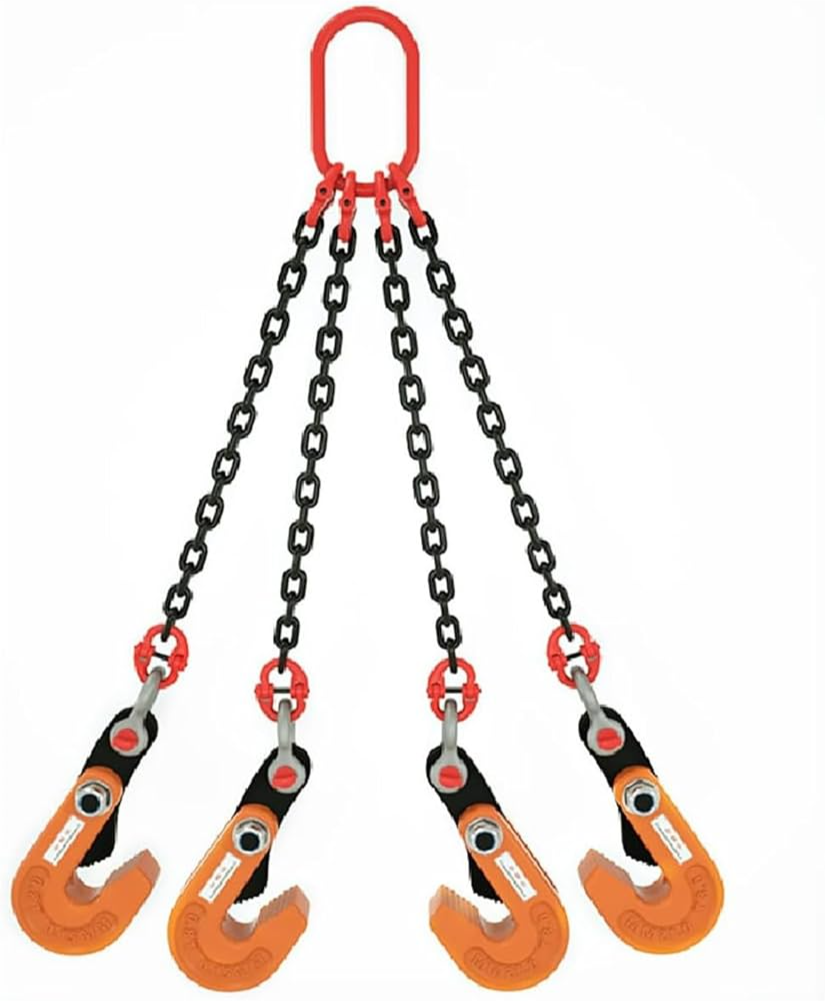
Every lifting operation depends on a fundamental principle: the equipment must be capable of safely supporting the load being lifted. Yet many people who work with chain slings don't fully understand how to calculate the actual capacity available for their specific application. This knowledge gap leads to one of two equally problematic outcomes: either operations select undersized slings that create dangerous situations, or they over-specify equipment, wasting money on capacity they don't need.
The difference between understanding and not understanding chain sling capacity calculations can literally be the difference between a safe operation and a catastrophic failure. A chain sling that appears strong enough might actually be inadequate for your specific lifting angle. A load that seems light enough might exceed the sling's capacity when distributed unevenly across multiple legs. These misunderstandings don't just waste money—they create serious safety risks.
This comprehensive guide walks you through the complete process of calculating chain sling capacity. You'll learn what working load limit means, how angle factors affect capacity, how to account for safety factors, and how to apply these concepts to real-world lifting scenarios. Whether you're selecting a sling for a specific job, verifying that existing equipment is adequate, or training personnel on proper rigging practices, this guide provides the knowledge you need to make accurate capacity calculations.
Working Load Limit, commonly abbreviated as WLL, represents the maximum load that a chain sling can safely support under normal working conditions [1]. This isn't the breaking strength of the sling—which is significantly higher—but rather the safe working capacity that accounts for safety factors, environmental conditions, and the realities of industrial lifting operations.
Every chain sling manufactured in compliance with industry standards carries a WLL rating. This rating is determined through rigorous testing and calculations that account for the material properties of the chain, the design of the sling assembly, and the safety factors required by standards such as OSHA, ASME, and ANSI [1]. The WLL is the number you use when determining whether a sling is adequate for your specific lifting application.
Understanding the distinction between breaking strength and working load limit is essential. A chain might have a breaking strength of 50,000 pounds, but its working load limit might be only 12,500 pounds. This difference isn't a flaw in the sling—it's a safety feature. The ratio between breaking strength and working load limit is the safety factor, which provides protection against unexpected loads, dynamic loading, and other factors that might increase stress beyond the static load calculation.
The working load limit of a chain sling is calculated using a formula that accounts for several factors: the grade of the chain material, the diameter of the chain links, the number of legs in the sling assembly, and the angle at which the sling will be used [2]. Manufacturers perform these calculations and then apply additional safety factors to ensure that the published WLL provides a margin of safety for actual field conditions.
For example, a single-leg chain sling made from Grade 100 alloy steel with 1/2-inch diameter links might have a working load limit of 15,000 pounds when used in a vertical lift. The same chain, when configured as a double-leg sling and used at a 60-degree angle, might have a combined working load limit of 26,000 pounds (13,000 pounds per leg at that angle). These calculations aren't arbitrary—they're based on proven engineering principles and industry standards [1].
A common mistake in rigging operations is assuming that if you know the breaking strength of a chain, you can simply divide by a safety factor to get the working load limit. While this approach might work in theory, it often doesn't account for the specific design of the sling assembly, the quality of the welds connecting the chain to the master link and hooks, or the actual performance characteristics of the complete assembly [2].
The published working load limit from the manufacturer is always the correct number to use. This number has been determined through testing and calculation by engineers who understand the complete sling assembly, not just the chain itself. Using any other number—whether calculated from breaking strength or estimated based on experience—introduces unnecessary risk into your lifting operations.
Chain slings are manufactured from different grades of alloy steel, with the most common grades being Grade 80, Grade 100, and Grade 120 [1]. These grades refer to the minimum tensile strength of the steel material, measured in thousands of pounds per square inch. A Grade 100 chain has a minimum tensile strength of 100,000 PSI, while a Grade 120 chain has a minimum tensile strength of 120,000 PSI.
The higher the grade, the stronger the material, and therefore the higher the working load limit for a given chain diameter. A Grade 100 chain is approximately 25% stronger than a Grade 80 chain of the same diameter. A Grade 120 chain is approximately 20% stronger than a Grade 100 chain of the same diameter. This relationship means that for the same physical size, a higher-grade chain can support a heavier load [2].
The diameter of the chain links directly affects the sling's capacity. A larger diameter chain can support a heavier load than a smaller diameter chain made from the same material. This relationship isn't linear—doubling the chain diameter increases the cross-sectional area by a factor of four, which increases the capacity by approximately four times [1].
Common chain diameters for lifting slings include 1/4 inch, 5/16 inch, 3/8 inch, 1/2 inch, 5/8 inch, and 3/4 inch. Each size has a specific working load limit when used as a single-leg vertical lift. For example, a Grade 100 chain with 3/8-inch diameter has a working load limit of approximately 8,800 pounds for a single-leg vertical lift, while a 1/2-inch diameter Grade 100 chain has a working load limit of approximately 15,000 pounds [2].
The following table shows typical working load limits for Grade 100 and Grade 120 chain slings in single-leg vertical lift configuration:
Chain Diameter | Grade 80 WLL | Grade 100 WLL | Grade 120 WLL |
1/4" | 3,500 lbs | 4,300 lbs | 5,200 lbs |
5/16" | 4,600 lbs | 5,700 lbs | 6,800 lbs |
3/8" | 7,100 lbs | 8,800 lbs | 10,600 lbs |
1/2" | 12,000 lbs | 15,000 lbs | 18,000 lbs |
5/8" | 18,300 lbs | 22,600 lbs | 27,200 lbs |
3/4" | 26,500 lbs | 33,000 lbs | 39,600 lbs |
Note: These are typical values for single-leg vertical lifts. Actual values may vary by manufacturer and specific sling design. Always refer to the manufacturer's specifications for your specific sling.
When a chain sling is used in a vertical lift, the load is distributed evenly along the sling. However, when the sling is used at an angle—which is common in many rigging applications—the stress on each leg of the sling increases. This increased stress reduces the effective capacity of the sling [1].
The relationship between angle and capacity is governed by trigonometry. As the angle increases (meaning the sling legs spread further apart), the stress on each leg increases. A sling used at a 30-degree angle experiences significantly more stress than the same sling used at a 60-degree angle. Understanding this relationship is critical for accurate capacity calculations [2].
Angle factors are multipliers that account for the effect of lifting angle on sling capacity. These factors are applied to the vertical lift capacity to determine the actual capacity at a specific angle. Common angle factors include:
<!--[if !supportLists]-->• <!--[endif]-->90-degree angle (vertical lift): Angle factor = 1.0 (no reduction)
<!--[if !supportLists]-->• <!--[endif]-->60-degree angle: Angle factor = 0.866 (13.4% reduction)
<!--[if !supportLists]-->• <!--[endif]-->45-degree angle: Angle factor = 0.707 (29.3% reduction)
<!--[if !supportLists]-->• <!--[endif]-->30-degree angle: Angle factor = 0.5 (50% reduction)
These factors are applied to each leg of a multi-leg sling. For example, if a double-leg sling has a vertical lift capacity of 20,000 pounds per leg (40,000 pounds total), and the sling is used at a 45-degree angle, the capacity per leg becomes 20,000 × 0.707 = 14,140 pounds per leg, or 28,280 pounds total [1].
Accurately determining the lifting angle is essential for correct capacity calculations. The angle is measured from the vertical to the sling leg. A vertical lift is 0 degrees (or sometimes described as 90 degrees from horizontal, depending on the measurement convention). A sling leg that extends at 45 degrees from vertical is a 45-degree angle [2].
In practice, measuring the exact angle during a rigging operation can be challenging. A common approach is to estimate the angle based on the geometry of the load and the lifting points. If the load attachment points are close together relative to the height of the lift, the angle will be steep (close to vertical, with a small angle factor). If the attachment points are far apart relative to the height, the angle will be shallow (far from vertical, with a larger angle factor and greater capacity reduction) [1].
A single-leg sling consists of one chain leg extending from the master link to a hook or attachment point. The working load limit for a single-leg sling is straightforward: it's the rated capacity of the chain for vertical lifting. Single-leg slings are used for loads with a single attachment point or for pulling applications [1].
When a single-leg sling is used at an angle, the capacity is reduced by the angle factor. For example, if a single-leg sling has a vertical lift capacity of 10,000 pounds and is used at a 45-degree angle, the capacity becomes 10,000 × 0.707 = 7,070 pounds [2].
A double-leg sling has two chain legs extending from a master link, allowing the load to be suspended from two points. When used in a vertical lift with the load evenly distributed between the two legs, each leg carries half the load. The total capacity is the sum of the capacities of both legs [1].
For example, if each leg of a double-leg sling has a vertical lift capacity of 10,000 pounds, the total vertical lift capacity is 20,000 pounds. When the same sling is used at a 60-degree angle, each leg's capacity is reduced by the angle factor: 10,000 × 0.866 = 8,660 pounds per leg, for a total capacity of 17,320 pounds [2].
Triple-leg slings have three chain legs, and quad-leg (or bridle) slings have four chain legs. These configurations distribute the load across more legs, but each leg experiences different stress depending on the specific geometry of the lift [1].
For a quad-leg sling used in a balanced vertical lift with the load evenly distributed, the total capacity is approximately four times the capacity of a single leg. However, if the load is unevenly distributed or if the sling is used at an angle, the calculation becomes more complex. In these situations, the leg carrying the most load determines the maximum safe load for the entire sling [2].
A safety factor is a multiplier that reduces the working load limit to account for uncertainties in real-world lifting operations. Industry standards typically recommend a minimum safety factor of 4:1, meaning the working load limit should be at least four times the maximum load being lifted [1].
This safety factor provides protection against several types of risk: dynamic loading (sudden jerks or impacts), uneven load distribution, environmental factors (temperature, corrosion), and the inherent variability in materials and manufacturing. A 4:1 safety factor doesn't mean the sling will fail if you exceed the working load limit by a small amount—it means there's a substantial margin of safety built into the working load limit [2].
To calculate the safe working load for a specific application, start with the working load limit for your sling configuration and angle, then divide by the safety factor. Using a 4:1 safety factor:
Safe Working Load = Working Load Limit ÷ 4
For example, if a double-leg chain sling has a working load limit of 20,000 pounds at a 60-degree angle, the safe working load with a 4:1 safety factor would be 20,000 ÷ 4 = 5,000 pounds. This means you should not lift loads heavier than 5,000 pounds with this sling configuration and angle [1].
While a 4:1 safety factor is standard in most industrial lifting operations, certain situations might warrant different safety factors. Critical lifts, lifts with high uncertainty about load weight, or lifts in harsh environments might require a 5:1 or even 6:1 safety factor. Conversely, routine lifts with well-known loads and stable conditions might use a 4:1 factor [2].
Always consult with a qualified rigger or your company's safety standards to determine the appropriate safety factor for your specific application. Never reduce the safety factor below 4:1 without explicit authorization from a qualified professional and documented justification [1].
The first step in any capacity calculation is accurately determining the weight of the load and how that weight will be distributed across the sling legs. Weigh the load if possible, or obtain the weight from documentation. Determine how many attachment points the load has and whether the weight will be evenly distributed [1].
If the load has multiple attachment points but the weight distribution is uneven, identify which attachment point will carry the most load. This point determines the maximum safe load for the sling, since each leg must be capable of supporting its portion of the load [2].
Based on the geometry of the load and the lifting points, determine the angle at which each sling leg will be used. Measure or estimate the angle from vertical. If you're uncertain, assume a smaller angle (steeper from vertical), which is more conservative and provides greater safety [1].
For multi-leg slings, determine the angle for each leg. In many cases, all legs will be at the same angle, but in some configurations, different legs might be at different angles. Calculate the capacity for each leg separately [2].
Using the angle you determined in Step 2, identify the corresponding angle factor. If your angle doesn't exactly match a standard value, use the angle factor for the next larger angle (which is more conservative). For example, if your angle is 50 degrees, use the 45-degree angle factor [1].
Using the chain diameter and grade of your sling, look up the base working load limit for a single-leg vertical lift. This is the starting point for all capacity calculations. Refer to manufacturer specifications or use a reference table [2].
Multiply the base working load limit by the angle factor to get the capacity at your specific lifting angle. This gives you the capacity for a single leg at the angle you'll be using. For example: 15,000 lbs (base WLL) × 0.866 (60-degree angle factor) = 12,990 lbs per leg [1].
If you're using a multi-leg sling, multiply the single-leg capacity by the number of legs. For a double-leg sling at 60 degrees: 12,990 lbs × 2 legs = 25,980 lbs total capacity. For a quad-leg sling: 12,990 lbs × 4 legs = 51,960 lbs total capacity [2].
Divide the calculated capacity by your safety factor (typically 4) to get the safe working load. For the double-leg example: 25,980 lbs ÷ 4 = 6,495 lbs safe working load [1].
Double-check your work by reviewing each step. Verify that you used the correct chain grade and diameter, applied the correct angle factor, accounted for all legs, and applied the appropriate safety factor. When in doubt, recalculate or consult with a qualified rigger [2].
Scenario: You need to lift a 6,000-pound load using a single-leg chain sling with 1/2-inch Grade 100 chain in a vertical lift.
Calculation:
<!--[if !supportLists]-->1 <!--[endif]-->Base WLL for 1/2" Grade 100 chain (vertical): 15,000 lbs
<!--[if !supportLists]-->2 <!--[endif]-->Angle factor for vertical lift: 1.0
<!--[if !supportLists]-->3 <!--[endif]-->Capacity at angle: 15,000 × 1.0 = 15,000 lbs
<!--[if !supportLists]-->4 <!--[endif]-->Applied safety factor: 4:1
<!--[if !supportLists]-->5 <!--[endif]-->Safe working load: 15,000 ÷ 4 = 3,750 lbs
Result: Your load of 6,000 pounds exceeds the safe working load of 3,750 pounds. This sling is inadequate for this application. You would need a larger diameter chain or a different sling configuration [1].
Scenario: You need to lift an 8,000-pound load using a double-leg chain sling with 3/8-inch Grade 100 chain at a 60-degree angle.
Calculation:
<!--[if !supportLists]-->6 <!--[endif]-->Base WLL per leg for 3/8" Grade 100 chain (vertical): 8,800 lbs
<!--[if !supportLists]-->7 <!--[endif]-->Angle factor for 60-degree angle: 0.866
<!--[if !supportLists]-->8 <!--[endif]-->Capacity per leg at angle: 8,800 × 0.866 = 7,621 lbs
<!--[if !supportLists]-->9 <!--[endif]-->Total capacity (2 legs): 7,621 × 2 = 15,242 lbs
<!--[if !supportLists]-->10 <!--[endif]-->Applied safety factor: 4:1
<!--[if !supportLists]-->11 <!--[endif]-->Safe working load: 15,242 ÷ 4 = 3,810 lbs
Result: Your load of 8,000 pounds exceeds the safe working load of 3,810 pounds. This sling configuration is inadequate. You would need a larger diameter chain or a different configuration [2].
Scenario: You need to lift a 15,000-pound load using a quad-leg chain sling with 1/2-inch Grade 100 chain at a 45-degree angle.
Calculation:
<!--[if !supportLists]-->12 <!--[endif]-->Base WLL per leg for 1/2" Grade 100 chain (vertical): 15,000 lbs
<!--[if !supportLists]-->13 <!--[endif]-->Angle factor for 45-degree angle: 0.707
<!--[if !supportLists]-->14 <!--[endif]-->Capacity per leg at angle: 15,000 × 0.707 = 10,605 lbs
<!--[if !supportLists]-->15 <!--[endif]-->Total capacity (4 legs): 10,605 × 4 = 42,420 lbs
<!--[if !supportLists]-->16 <!--[endif]-->Applied safety factor: 4:1
<!--[if !supportLists]-->17 <!--[endif]-->Safe working load: 42,420 ÷ 4 = 10,605 lbs
Result: Your load of 15,000 pounds exceeds the safe working load of 10,605 pounds. This sling configuration is still inadequate. You would need to use Grade 120 chain or a larger diameter [1].
One of the most common errors in capacity calculations is failing to apply the angle factor when the sling is used at an angle. This error can result in significant overestimation of sling capacity. Always determine the lifting angle and apply the corresponding angle factor [1].
Another common error occurs when loads are not evenly distributed across sling legs. If a quad-leg sling is lifting a load where one attachment point carries more weight than the others, that leg determines the maximum safe load for the entire sling, not the average load per leg [2].
Failing to accurately determine load weight can result in selecting undersized slings. Always weigh loads when possible, or obtain weight information from reliable sources. Never estimate load weight based on appearance alone [1].
Some operations attempt to maximize sling utilization by using the full working load limit without applying a safety factor. This practice eliminates the margin of safety that protects against dynamic loading, uneven distribution, and other real-world factors. Always apply an appropriate safety factor [2].
Using a sling assembly made from mixed chain grades or sizes can result in capacity calculations that don't match the actual assembly. Always verify that all components of a sling are the same grade and size [1].
After completing your capacity calculation, verify your result against the manufacturer's specifications for the specific sling you're using. If your calculation differs significantly from the manufacturer's rating, review your calculation for errors or consult with the manufacturer [1].
For critical lifts or routine operations, document the capacity calculations and keep records with the sling. This documentation serves multiple purposes: it provides verification that the sling is adequate for the intended use, it helps train personnel on proper sling selection, and it provides a record for safety audits and investigations [2].
As slings age and experience use, their actual capacity might change due to wear, corrosion, or damage. Periodically verify that slings continue to meet the capacity requirements of their intended applications. Damaged slings should be removed from service or repaired before being used again [1].
Calculating chain sling capacity accurately is a fundamental responsibility for anyone involved in lifting and rigging operations. The process isn't complicated—it requires understanding working load limits, applying angle factors, accounting for multiple legs, and applying appropriate safety factors. By following the step-by-step process outlined in this guide and avoiding common errors, you can confidently select and use chain slings that are adequate for your specific applications.
Ready to ensure your lifting operations use properly calculated chain sling capacities? Our team at lifting-chain.com specializes in helping operations like yours select, configure, and verify chain slings that match your specific capacity requirements. We can help you:
<!--[if !supportLists]-->• <!--[endif]-->Calculate accurate capacity requirements for your specific lifting applications
<!--[if !supportLists]-->• <!--[endif]-->Select the right chain sling configuration and size for each application
<!--[if !supportLists]-->• <!--[endif]-->Verify that existing slings are adequate for their intended uses
<!--[if !supportLists]-->• <!--[endif]-->Establish capacity documentation and verification procedures
<!--[if !supportLists]-->• <!--[endif]-->Train your personnel on proper capacity calculations and sling selection
<!--[if !supportLists]-->• <!--[endif]-->Source high-quality chain slings from trusted manufacturers